Northern Moose Alliance
Moose Research Background
Minnesota’s northeastern moose are a defining part of the North Woods and a living symbol of the boreal forest. But over the last two decades, the population has declined sharply.
This decline has ecological consequences for Minnesota’s forests and is especially significant within the 1854 Ceded Territory, where moose — Mooz in the Ojibwe language — are central to Ojibwe treaty-reserved rights and remain an important subsistence and cultural resource.
Minnesota has a long history of strong moose research. Scientists and wildlife managers have learned a great deal from past moose research in Minnesota. But there is still a major gap: we know much less about what happens to moose after calfhood but before full adulthood. These “in-between” years often determine whether young moose survive long enough to join the breeding population and help the population recover.
Northeastern Minnesota
Northeastern Minnesota
Over roughly two decades
The Core Need: Recruitment Into The Breeding Population
When moose biologists talk about recruitment, they mean how many young moose survive long enough to become reproducing members of the population and when they begin reproducing.
In Minnesota, past research has focused heavily on adult moose and newborn calves, which improved key inputs for population models. What’s been missing is a clear picture of young moose (roughly ages 1–3), a life stage that can strongly influence whether the population stabilizes or continues to decline.
This research is designed to fill that gap by completing the missing “middle chapter” of the moose life story, the transition from surviving the first winter to successfully entering the breeding population.
For details on what the team will measure and how, please visit Research Objectives, a plain-language summary of the study questions and what the team will measure, and our Research Timeline, which includes key project phases and milestone dates.
Why This Gap Exists
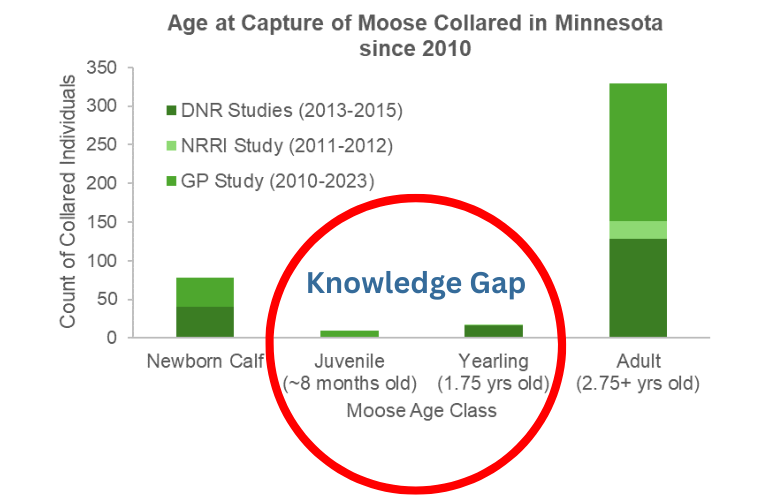
The above graphic shows the age at capture of moose collared in northeastern Minnesota since 2010. Most collared moose have been newborn calves or adults, with far fewer juveniles, yearlings, and young adults represented. This pattern illustrates a key knowledge gap about the years when moose transition into the breeding population.
Earlier studies were designed around questions that were best answered by tracking calves and fully mature moose, such as newborn survival and adult mortality. Capturing and monitoring “in-between” age classes is more logistically challenging and has historically been less common, which means we have fewer long-term data on what happens between a calf’s first year and the point when a moose becomes a breeding adult.
What’s Driving The Decline — and Why Young Moose Matter
Scientists widely agree that climate change is the overarching stressor shaping the future of moose in Minnesota. Warmer temperatures affect snow conditions, forage availability, parasite survival, and disease dynamics. These broad climate pressures manifest through several proximate causes that directly affect moose survival:
- Winter ticks, which can cause severe blood loss, hair loss, and energy depletion
- Brainworm infections, transmitted by white-tailed deer and often resulting in paralysis and nutritional stress
- Predation, particularly by wolves, which can have compounding effects when moose are already weakened by disease or parasites
Decades of research have greatly advanced understanding of these stressors and their effects on adult moose and newborn calves. Survival rates, causes of mortality, and calf outcomes are now much better quantified than they were in the early 2000s.
Those pressures don’t affect every age class the same way. That’s why focusing on young moose matters: the results can help clarify whether the biggest constraints on recovery are happening through:
- Lower reproduction, which could point toward habitat or forage limitations; or
- Lower survival even when reproduction is high, which could shift attention toward parasite and predator dynamics.
Without strong data on yearlings and 2-year-olds, it’s difficult to choose management strategies that have the best chance of supporting moose recovery.
Co-Stewardship and Research Collaboration: Shared Responsibility, Shared Future
This project is a co-stewardship effort between state and Tribal partners — bringing together shared leadership, on-the-ground expertise, and a commitment to applying the results in real-world management.
Within the 1854 Ceded Territory, Ojibwe tribes maintain treaty-reserved rights to hunt, fish, and gather, and moose remain an important subsistence food resource and cultural connection across generations. Addressing moose decline is not only a wildlife management challenge. It is also a shared stewardship responsibility, rooted in relationships to land, wildlife, and treaty commitments
Key partners include the Minnesota Department of Natural Resources, 1854 Treaty Authority, University of Minnesota Duluth (NRRI), the Grand Portage Band of Lake Superior Chippewa, and the National Parks of Lake Superior Foundation.
How This Connects With Ongoing Grand Portage Moose Research
New knowledge doesn’t begin in isolation. This research builds on work already underway, including the Grand Portage Band of Lake Superior Chippewa’s experience studying moose. Research by the Grand Portage Band of Chippewa helped demonstrate that young moose can be captured and collared safely during their first winter and monitored for survival, habitat use, and mortality causes. This provides a foundation that can be expanded across the broader core moose range in northeastern Minnesota.
Separately, but complementarily to the Minnesota ENRTF/LCCMR work plan, the Grand Portage Reservation and NPLSF have a reimbursable agreement focused on moose research and restoration activities on Grand Portage Reservation lands, Minong (Isle Royale National Park), and the 1854 Ceded Territory, including support such as monitoring collared moose, coordinating field responses, assisting with sample collection, reviewing thermal video, updating a project website, and providing presentations to interested groups.
Explore the Research
Looking for the full context? These pages cover background, funding, updates, timeline, partners, and related moose resources.
Objectives
Survival, pregnancy, calving, and habitat use — what we’re measuring and how.
Moose Resources
News, videos, partner reports, and research explaining moose survival.
Stay Connected To Moose Research
This work depends on more than scientists in the field. It depends on informed, engaged people who care enough to stay connected.
We’d love to keep you updated as this work evolves and share ways you can help protect moose as opportunities arise. Please join our quarterly newsletter for exclusive updates, expert moose insights, and actions you can take.
Interested in contributing directly to the research? Visit our Citizen Science Portal to share trail-camera photos or videos that can help researchers assess possible winter tick-related hair loss and better understand moose health across the northeastern range.
Interested in staying connected in other ways, too? Explore resources built for the field and the community, including Moose Safety and Viewing Etiquette plus a social-media toolkit.